Thursday, 20 December 2012

Not My Job: We Quiz NASA Engineers On Mars Candy

Missions engineers Bobak Ferdowsi (left) and Adam Steltzner — also known as "Mokawk guy" and "Elvis guy," respectively — helped land the Mars Curiosity rover on Sunday night.

Missions engineers Bobak Ferdowsi (left) and Adam Steltzner — also known as "Mokawk guy" and "Elvis guy," respectively — helped land the Mars Curiosity rover on Sunday night.

Left: Brian van der Brug-Pool/Getty Images/Right: Bill Ingalls/NASA via Getty Images

This segment was originally broadcast on Aug. 8, 2012.

On a Sunday night in August, while the rest of us were ooohing and aaahing over gymnastics, a bunch of propeller heads at NASA and the Jet Propulsion Laboratory were flawlessly steering a billion-dollar robotic space laboratory the size of a minivan to a landing on Mars.

Missions engineers Bobak Ferdowsi and Adam Steltzner — whose hairstyles have led them to be nicknamed "Mokawk guy" and "Elvis guy," respectively — are two of the guys behind the landing of the Mars rover Curiosity, and very well might be the Sexiest Nerds Ever.

We've invited Ferdowsi and Steltzner to play a game called "Try landing on this Mars!" Believe it or not, it is actually easier to get a camera onto the surface of planet Mars than into the factory of the incredibly secretive Mars candy company. We'll ask two experts on Mars the planet three questions about Mars the candy.

Copyright © 2012 National Public Radio. For personal, noncommercial use only. See Terms of Use. For other uses, prior permission required.

CARL KASELL: From NPR and WBEZ-Chicago, this is WAIT WAIT...DON'T TELL ME!, the NPR News quiz. I'm Carl Kasell, and here's your host, at the Chase Bank Auditorium in downtown Chicago, Peter Sagal.

PETER SAGAL, HOST:

Thank you, Carl.

(APPLAUSE)

SAGAL: Thank you everybody. Thank you everybody, great to see you all. Sometimes it amazes me that here I am, speaking into a small black object, here in Chicago, and yet, somehow, my voice gets all the way to you through a miracle involving wires and electricity and people who stare at me blankly, from behind glass, while they press buttons.

KASELL: It's one of the world's greatest unsolved mysteries, Peter.

SAGAL: I've always assumed invisible elves were listening to me, then flying out across the country and hiding in your radios to repeat what they hear.

(LAUGHTER)

SAGAL: But, it turns out, it's science.

KASELL: Or maybe the elves just don't have their cover blown.

(LAUGHTER)

SAGAL: We're going to go with science, at least for this hour. Today, we have some of our favorite interviews with scientists. Super nerds, who can tell us all kinds of things we're not smart enough to understand but maybe you can figure out.

KASELL: We begin with two men who did something pretty cool. They drove a car all the way to Mars.

SAGAL: Bobak Ferdowsi and Adam Steltzner joined us right after they landed the Curiosity rover on Mars, along with panelists Amy Dickinson, Roy Blount, Jr., and Tom Bodett.

(APPLAUSE)

SAGAL: So, first of all, let's identify you guys. Bobak, you are known now, I believe all of the world as the Mohawk Guy.

BOBAK FERDOWSKI: That's me.

SAGAL: That's you, okay.

(LAUGHTER)

SAGAL: And before you became the Mohawk Guy, what was your title?

FERDOWSKI: I was a flight director, or I still am, a flight director on the Mars Science Lab Mission.

SAGAL: No, now you're the Mohawk Guy.

(LAUGHTER)

SAGAL: I'm sorry. I checked the internet. That's who you are. And Adam, you are known also colloquially as the Elvis Hair Guy.

ADAM STELTZNER: Yes, it's a heavy responsibility.

(LAUGHTER)

SAGAL: Right, to be the Elvis Hair Guy. And Adam, what is your job at JPL?

STELTZNER: I'm in charge of the landing of Curiosity.

SAGAL: Right.

TOM BODETT: How'd that go?

AMY DICKINSON: Yeah.

(APPLAUSE)

STELTZNER: Yeah, we could talk about that.

SAGAL: So Bobak, you're the flight director and Adam, you were in charge of the landing. The landing was so insanely complicated, you had the heat shied and the parachute and the sky crane and all this cool stuff. How in the world did you know it would work?

STELTZNER: You know, the proof of the pudding is in the tasting and we didn't really know it would work. I had the hardest time believing it would work myself. You know, we made models of it in computers and we tested pieces that we thought we could test, but in the end, you never know if it's all going to come together.

SAGAL: Right. So basically, the first time that you ever actually tried this in the real world was on Mars on Sunday?

DICKINSON: No.

STELTZNER: Yes, that's correct.

SAGAL: Wow. So Adam, tell me about your background. Because what we read, you were like a rock and roll guy for a while, right?

STELTZNER: Right. I was not the best student in high school. So, I stopped going to high school.

SAGAL: Really?

STELTZNER: And started playing music. And after a few years of that, playing rock and roll in the San Francisco Bay area, I became intrigued at the fact that there were a different set of stars in the sky as I'd drive home from playing a show as there had been when I went to the show. And I had some vague recollection about something moving with respect to something else. But I frankly didn't really know what it was.

BODETT: But then you stopped taking drugs, right?

(LAUGHTER)

STELTZNER: That's right.

SAGAL: And so then you...

STELTZNER: So then I went down to the local community college to try and figure out why those stars were moving. Then I started to make up for my lack of high school education, so on and so forth, and then I'm here.

SAGAL: Right. And what had you done to - congratulations.

(APPLAUSE)

DICKINSON: Amazing.

SAGAL: And what had you done to sort of qualify yourself to be the guy in charge of landing this rover?

STELTZNER: That's a really good question. I continually ask myself that.

(LAUGHTER)

SAGAL: And Bobak, you were the flight director. What does that mean?

FERDOWSKI: I'm sort of like that Ed Harris character in "Apollo 13." But our job is decidedly less dramatic, except for those last seven minutes.

SAGAL: Really? So you're the guy who's in charge of, like being in the middle of the room and sort of shouting out commands to people...

FERDOWSKI: That's right.

SAGAL: ...as they stare at monitors.

FERDOWSKI: Pretty much.

SAGAL: Yeah.

(LAUGHTER)

SAGAL: And you're famous because when people tuned into the video on Sunday to watch the landing, they saw you in charge in the room, wearing this rather remarkable hairdo, the Mohawk.

(LAUGHTER)

SAGAL: I mean just like Ed Harris, or rather the real life person, in the Apollo missions had a new vest for every mission, you have a new hairstyle for every mission?

FERDOWSKI: That's exactly right. For all the big events on this project, like launch and everything else, I've had a completely different hairstyle. The last one was voted on by the team when somebody sent out an internet poll for the whole team to vote on.

SAGAL: Wow. And they voted on a Mohawk. And these are your friends.

(LAUGHTER)

SAGAL: Talk to me about your internet fame. Bobak, in particular you have become like, you've become a practical meme. We understand you've been getting a lot of marriage proposals via twitter, which shows real commitment to you as a person.

(LAUGHTER)

SAGAL: What is instant internet fame like?

FERDOWSKI: It's so crazy. I can't believe it. I'm still kind of getting over the fact that we just put something on Mars. But, it's a lot of...

SAGAL: No, no, no, tell me about the girls. I want to hear about the groupies.

(LAUGHTER)

FERDOWSKI: They're super nice, you know.

(LAUGHTER)

SAGAL: You're the flight director, Bobak. You're the guy in charge of landing, Adam. It flew there and it landed. Aren't you two guys out of a job now?

(LAUGHTER)

STELTZNER: Well, Bobak is still going to work the surface mission because they still need, you know, flight directors for that. But I am certified out of a job.

SAGAL: Really? So what are you going to do now?

STELTZNER: I'm going to start looking for work.

SAGAL: Really? So you're going to be like unemployed rocket scientist, genius, landed thing on Mars, can stamp cans?

STELTZNER: Will land on Mars for food.

ROY BLOUNT JR: There you go.

(LAUGHTER)

(APPLAUSE)

SAGAL: Well, Adam and Bobak, we are delighted to have you here. We have asked you here to play a game that this time we are calling?

KASELL: Try landing on this Mars.

(LAUGHTER)

SAGAL: It is actually easier to get a camera onto the surface of Mars than into a Mars candy factory. The company is incredibly secretive. We're going to ask you three questions about Mars, the candy company, and if you get two right, you'll win our prize for one of our listeners, Carl's voice on their home answering machine. Carl, who are Adam and Bobak playing for?

KASELL: Adam and Bobak are playing for Adair Emmons of Portland, Maine.

(APPLAUSE)

SAGAL: You guys ready to play?

FERDOWSKI: Ready to play.

SAGAL: All right, and remember: You are rocket scientists. Don't screw this up.

(LAUGHTER)

SAGAL: Mars is known for its very modest corporate culture, up to and including the family members who run the company. Which of these rules do the company executives have to follow?

A: For trips of less than 100 miles, they are required to travel by Greyhound Bus? B: Instead of cell phones, each executive is given a roll of quarters for payphones and told to bring back the change? Or C: Each executive, including the CEO of the company, has to punch in and out of work on a time clock?

STELTZNER: We think C.

SAGAL: Did you actually consult or did you just decide for the team there, Adam?

(LAUGHTER)

FERDOWSKI: Adam's the team lead, so he always decides.

SAGAL: I understand. Do you do that? You're just like we're hungry now?

(LAUGHTER)

SAGAL: We feel like a pizza.

STELTZNER: We don't like what you're saying.

(LAUGHTER)

(APPLAUSE)

SAGAL: All right then. But the team has collectively decided that the answer is C, the time clock?

STELTZNER: C as in Curiosity.

SAGAL: Yes. Well you guys are right. Yes, it was the time clock. They all have to punch in and out.

(SOUNDBITE OF BELL)

(APPLAUSE)

SAGAL: Even if you are, as the CEO of Mars is, the grandson of the founder and the owner of the company. All right, the company is famously efficient. For example, the company's legendary boss, Forrest Mars, son of the founder, he used to do what to save money? A: He would scrape chocolate off the faces of kid taste testers to melt down and use again?

(LAUGHTER)

SAGAL: B: He would feed the pigs at his private farm with defective M and Ms? Or C: he changed the typeface on M and Ms to sans serif to save money on the ink that he would no longer have to use?

STELTZNER: We think it's C.

SAGAL: You think it's C.

(LAUGHTER)

SAGAL: Mission control says C, they changed the typeface to save a little ink without the serifs.

STELTZNER: Yes, confirmed.

SAGAL: Confirmed. Thank you, mission control; you are incorrect.

DICKINSON: Oh.

SAGAL: I'm sorry. Actually, what happened was is he had a private farm with pigs and he was very meticulous about M and Ms. If any of them were defective, had a little typo - a typo on M and Ms, he would...

(LAUGHTER)

SAGAL: ...take them down and use them for pig food. This is very exciting. The company is extremely secretive, Mars is. So much so that what? A: Outsiders who come into the factory to work are blindfolded as they enter and walk across the factory floor? B: Until the law required them to change it, the ingredients on a Mars Bar were listed as "Wouldn't you like to know"?

(LAUGHTER)

SAGAL: Or C: If an employee is asked where they work, they're required to say, The CIA?

(LAUGHTER)

FERDOWSKI: I'm going to go with A as in Adam.

SAGAL: Bobak, you're going for A. Adam, do you agree?

STELTZNER: I'm going to follow the flight director on this one.

SAGAL: You're going to go with A. Correct, a successful landing onto the correct answer.

(SOUNDBITE OF BELL)

(APPLAUSE)

SAGAL: If you are a contractor and you have to work on the floor, they will blindfold you as they bring you to your place so you can't tell the world their secrets. Carl, how did our guests do?

KASELL: They did very well, Peter. Two correct answers, that's good enough to win for Adair Emmons.

SAGAL: Well done guys.

(APPLAUSE)

SAGAL: So last weekend you landed a rover on Mars. This weekend, you won on this quiz. What are you going to do next weekend?

FERDOWSKI: I'm going to try to get Carl to record a message on a Mars rover.

SAGAL: There you go.

(SOUNDBITE OF CHEERING)

KASELL: I'll be glad to.

FERDOWSKI: I'm going to hold you to that, Carl.

KASELL: Okay.

SAGAL: He'll do it. He'll be there for you. Bobak Ferdowsky and Adam Steltzner are two of the men behind the Mars Curiosity mission. Bobak and Adam, thank you so much for being on WAIT WAIT...DON'T TELL ME! Congratulations on that insanely cool thing you did.

(APPLAUSE)

SAGAL: Thanks so much.

FERDOWSKI: Thank you.

SAGAL: Bye-bye, guys.

FERDOWSKI: Bye-bye.

STELTZNER: Bye.

(SOUNDBITE OF MUSIC)

Copyright © 2012 National Public Radio. All rights reserved. No quotes from the materials contained herein may be used in any media without attribution to National Public Radio. This transcript is provided for personal, noncommercial use only, pursuant to our Terms of Use. Any other use requires NPR's prior permission. Visit our permissions page for further information.

NPR transcripts are created on a rush deadline by a contractor for NPR, and accuracy and availability may vary. This text may not be in its final form and may be updated or revised in the future. Please be aware that the authoritative record of NPR's programming is the audio.


View the original article here

Jake Tapper Of ABC News Plays Not My Job

Jake Tapper Ely Brown/Little, Brown and Company

Jake Tapper is the longtime chief White House correspondent for ABC News and has just written a new book called The Outpost: An Untold Story of American Valor.

We've invited him to play a game called "It's Mr. Bojangles to you." Three questions for a guy named Tapper about an actual tapper: Bill "Bojangles" Robinson, who some say was one of the greatest tap dancers of all time.

Copyright © 2012 National Public Radio. For personal, noncommercial use only. See Terms of Use. For other uses, prior permission required.

PETER SAGAL, HOST:

And now the game where we ask interesting and knowledgeable people about something they know nothing about.

(LAUGHTER)

SAGAL: Jake Tapper is the longtime Chief White House Correspondent for ABC News. He is the author of the extraordinarily interesting and terrifying new book, "The Outpost: An Untold Story of American Valor." Jake Tapper, welcome to WAIT WAIT...DON'T TELL ME!

JAKE TAPPER: It's great to be here, thank you.

(APPLAUSE)

SAGAL: So, Jake, for the new book, you spent a lot of time around soldiers in Afghanistan. Is it intimidating being around those guys?

TAPPER: It was very humbling just because, you know, the toughest day I'll have is check tots, speaking too loudly when I'm trying to do a live shot, or, you know, the makeup gets on my collar. My makeup.

(LAUGHTER)

SAGAL: Media is hell, Jake.

TAPPER: Yeah, I know. Or the wakeup calls, oh, the wakeup call.

SAGAL: Do you ever - I mean, again, and I refer to my own much more limited experience, do you ever find yourself coming up with things that might match their exploits? Like you would say, for example, "Well, you know, you guys might have fought this terrifying war in the far side of the world, but I dated Monica Lewinsky?

(LAUGHTER)

TAPPER: No, it was one nice dinner date and it was certainly nothing...

(LAUGHTER)

SAGAL: See, here's the thing...

ADAM FELBER: You were saying that.

SAGAL: Everybody thought I was kidding, but I'm not kidding.

(LAUGHTER)

TAPPER: I did go on one date with her before the story broke. It was one of the most...

(LAUGHTER)

SAGAL: It was before the story broke but after the story happened, if you know what I mean.

TAPPER: Yeah, it was very surreal.

SAGAL: Yeah.

TAPPER: It was definitely one of the most surreal moments, especially for a journalist. I had gone out to dinner with her. She seemed like a nice girl. She was moving to New York. She seemed very eager to get out of Washington, DC.

SAGAL: Can't imagine why.

(LAUGHTER)

TAPPER: I wasn't really sure what was going on. She seemed a little naïve, but, you know, a lovely girl, nice, whatever. And then I went on vacation with my dad and I was in the shack that passes for an airport in Little Cayman. My dad and I went scuba diving.

And there was the local newspaper, the Caymanian Compass, and it was the story about, you know, the White House rocked by this scandal and there was - oh my god.

(LAUGHTER)

SAGAL: This must get you, to this day, pride of place in the White House Press Room, right?

TAPPER: You know, it's so long ago and so many years ago that people don't really talk about it much.

SAGAL: Ah, I do.

TAPPER: Or at least not when I'm around.

(LAUGHTER)

BRIAN BABYLON: She never forgot the date. Man, she still thinks about you, man.

(LAUGHTER)

BABYLON: She never forgot how nice you were.

(LAUGHTER)

SAGAL: So, Jake, you...

FELBER: I finally meet a nice guy and it's too late. I got to leave town.

(LAUGHTER)

SAGAL: I can tell we're not going to do anything else. Let's just go through...

(LAUGHTER)

SAGAL: No, I'm not going to do that. I did want to talk to you, because it's amazing, you wrote for the Washington City paper and then Salon and you worked your way up to I think the extremely impressive position of chief White House correspondent for ABC News. When you got that role, was there like a ceremonial passing over of Sam Donaldson's hair to you? How does that work?

(LAUGHTER)

TAPPER: No, he's still got it.

SAGAL: That's his. He's not letting...

TAPPER: No, I mean it's a great chair; it's a great honor. I mean, it's a demanding job and everything. Sometimes I forget where I am, and, you know, we all have our impressions of the President that we do.

SAGAL: Wait a minute, you don't mean like an impression like "I feel he's a serious man who has a problem connecting." You mean like here's my Barack Obama impression, listen up.

TAPPER: Right, like much more Rich Little-esque.

SAGAL: All right. Well, now you've pitched that...

TAPPER: Well, my only point is that he came into the pressroom, and without even thinking, I said "hello, everybody," which is what he says every time he walks in.

(LAUGHTER)

TAPPER: And I kind of forgot that all the cameras were on. "Hello, everybody." And he looked at me and he smiled and he goes, "That's pretty good."

(LAUGHTER)

(APPLAUSE)

FELBER: And that was pretty good right there.

SAGAL: You know, we sit around and make jokes about you guys in the White House Press Corps and what you do, but I imagine it's somewhat intimidating to stand up on live national TV when he does one of his press conferences, and challenge the president. Do you ever feel a little nervous? You've done it not just with President Obama but you asked questions of President Bush as well, right?

TAPPER: It's a little intimidating, but it's also our job. And it's also - I mean, I think most of us are the kinds of people who, you know, like being annoying in that way.

(LAUGHTER)

SAGAL: Have you ever been yelled at? I remember Brian Williams once told us a story of getting a phone call from a very angry President Clinton about something that Brian had reported. Have you ever gotten anger response from any of these powerful people you've reported on?

TAPPER: Sure, all the time.

SAGAL: I mean, do they get in your face and they yell at you?

TAPPER: They mainly - you know, they mainly release the hounds kind of thing.

SAGAL: Right.

TAPPER: It's mainly their people. One time, I was walking - you know, one of the cool things about working at the White House is that you do tend to be able to bump into people in positions of power. And Security Clinton had just gotten the job as Secretary of State, so this is early on.

And I ran into her and I said, "Oh, Senator Clinton. I'm sorry, I mean Secretary Clinton, how are you? It's funny, which honorific do you prefer? Do you prefer Senator or do you prefer Madame Secretary?" And she said, "I'd prefer either of them to what we call you when you're not around."

(LAUGHTER)

SAGAL: Whoa.

FELBER: Whoa.

AMY DICKINSON: Whoa.

BABYLON: Whoa.

DICKINSON: Which makes me...

FELBER: That's a good one.

DICKINSON: That's make me think, Jake, like the cabinet is impersonating you guys.

SAGAL: Yeah.

(LAUGHTER)

FELBER: I'm Jake Tapper.

(LAUGHTER)

SAGAL: Oh, I'm Jake Tapper. Hey Monica, nice beret, you know.

(LAUGHTER)

TAPPER: They probably do.

SAGAL: Well, Jake Tapper, we are delighted to talk to you, but we have invited you here to play a game we're calling?

CARL KASELL: It's Mister Bojangles to you.

(LAUGHTER)

SAGAL: So, you're named Tapper, but you're a reporter. That makes no sense. So we thought we'd ask you three questions about an actual tapper, Bill Bojangles Robinson, who some say was one of the greatest tap dancers ever. Get two right, you'll win our prize for one of our listeners: Carl's voice on their voicemail. Carl, who is Jake Tapper playing for?

KASELL: He is playing for Andrew Rossow from Northfield, Minnesota

SAGAL: All right, you ready to go, Jake?

TAPPER: I am.

SAGAL: Here we go, your first question. Bill Bojangles Robinson was one of the greatest tap dancers in history but he also had another distinction. What was it? A: he invented the sport of greyhound racing? B: He held the record for the backwards 75-yard dash? Or C: He introduced Thai food to the American public?

DICKINSON: Huh.

TAPPER: What?

(LAUGHTER)

TAPPER: I'll go with B.

SAGAL: You're going to go with B: he held the record for the backwards 75 yard dash.

TAPPER: Yeah.

SAGAL: That's true.

(SOUNDBITE OF BELL)

SAGAL: He could run backwards very fast.

DICKINSON: Wow.

(APPLAUSE)

FELBER: So who did bring us Thai food?

(LAUGHTER)

SAGAL: I imagine a very large number of Thai people.

FELBER: Yeah.

SAGAL: That would be my guess.

FELBER: Brought it all the way from the old country.

SAGAL: Yeah, exactly. All right, second question. Bojangles most famous routine, of course, was the stair dance. You've seen him do that with Shirley Temple. He says he invented that routine spontaneously when what happened?

A: He was going downstairs drunk, he tripped, and managed to keep his feet all the way to the bottom? B: He watching an early version of the slinky descend some stairs in his home and went "aha." Or C: He was at the bottom of the stairs, the King of England was at the top of the stairs, and it just happened?

TAPPER: I'm going to go with A.

SAGAL: You're going to go with A: he was drunk, fell down the stairs, caught himself, "hey, I just did a dance." No, it was actually C. He says, the story he told, that he was getting an award from the King of England. The King of England was at the top of the stairs. He was supposed to go up there to meet him and he just danced his way up, spontaneously.

TAPPER: You know, I shouldn't have gone with the admitting drunk thing, because it was like during Prohibition probably.

SAGAL: Yeah, probably.

DICKINSON: But also isn't that stair dance, he goes up two, he comes down one, he goes up three, he comes down.

SAGAL: Yeah, yeah, yeah.

DICKINSON: I would not do that to the King.

BABYLON: No.

DICKINSON: I don't know.

(LAUGHTER)

SAGAL: You don't want to keep the king waiting.

DICKINSON: No. It's like tricky.

FELBER: He could use that knighting sword for a very different purpose if you keep him up too long.

SAGAL: Yeah, exactly.

(LAUGHTER)

SAGAL: Well, he would tell stories about himself that may or may not have been true.

FELBER: Yeah.

SAGAL: For example, he once told the story that his original name was Luther, not Bill, but he wanted the name Bill, so he beat up his brother Bill and took it.

(LAUGHTER)

SAGAL: That's a story he told about him. You never now with Bojangles, is what I'm saying.

BABYLON: You never know.

(LAUGHTER)

SAGAL: This is an exciting thing, because now if you get this one right, you win. Here we go. He was an inspiration to many dancers, one of whom, Fred Astaire, played tribute to Bojangles in Fred Astaire's movie "Swing Time" by doing what?

A: Falling down a flight of stairs onto his face, getting up and saying to the camera, "You get what you pay for." B: Saying, "Why, I'm nothing compared to Bill Bojangles Robinson." Or C: Doing a big dance number in blackface.

TAPPER: Oh god.

(LAUGHTER)

TAPPER: It's probably C, which is horrific.

(LAUGHTER)

TAPPER: OK, I'm going to go with C and I should also just say I do not support that.

SAGAL: Yes.

(LAUGHTER)

(APPLAUSE)

DICKINSON: Oh sure.

SAGAL: You're merely choosing it. Sadly, it was true. That's what Fred Astaire did.

(SOUNDBITE OF BELL)

SAGAL: It's rather one of the more uncomfortable moments for fans of Fred Astaire in that he does this big number, not only in blackface but in this big cartoony suit that was supposed to represent Bojangles' style. He meant it well, what can we say?

BABYLON: Those were different times back then.

SAGAL: It was a different time.

BABYLON: A very different time.

SAGAL: A very different time. Carl, how did Jake Tapper do on our quiz?

KASELL: Jake, you had two correct answers, so you win for Andrew Rossow.

TAPPER: All right.

(APPLAUSE)

SAGAL: Well done. So, Jake, I got to ask you, you spent all this time and effort and energy writing this extraordinarily harrowing book about the war in Afghanistan. Are you going to do something easy next?

TAPPER: My daughter wants me to do a children's book.

SAGAL: OK.

TAPPER: Because she doesn't understand why I'm spending all this time with soldiers instead of with kids.

SAGAL: Right.

TAPPER: She's five.

SAGAL: Right.

TAPPER: And by the way, I would have totally aced that My Little Pony quiz you gave to Bill Clinton.

SAGAL: Yes.

(LAUGHTER)

SAGAL: You know, it's funny, you and he have so much in common.

(LAUGHTER)

(APPLAUSE)

SAGAL: Yeah.

TAPPER: Actually Peter, not really.

(LAUGHTER)

SAGAL: Jake Tapper is the author of the extraordinary new book, "The Outpost." It's going to be on the New York Times bestseller list, deservedly so. Go get it; go read it. You will thank me. Jake Tapper, thank you so much for being with us on WAIT WAIT...DON'T TELL ME!

TAPPER: Thank you, Peter.

SAGAL: A pleasure to talk to you.

(APPLAUSE)

SAGAL: Bye-bye.

TAPPER: Bye-bye.

(SOUNDBITE OF MUSIC)

Copyright © 2012 National Public Radio. All rights reserved. No quotes from the materials contained herein may be used in any media without attribution to National Public Radio. This transcript is provided for personal, noncommercial use only, pursuant to our Terms of Use. Any other use requires NPR's prior permission. Visit our permissions page for further information.

NPR transcripts are created on a rush deadline by a contractor for NPR, and accuracy and availability may vary. This text may not be in its final form and may be updated or revised in the future. Please be aware that the authoritative record of NPR's programming is the audio.


View the original article here

NIH Director Francis Collins Plays Not My Job

Francis Collins NIH

Dr. Francis Collins is the director of the National Institutes of Health, which among other things means he's going to outlive us all. We've invited him to play a game called "OWWW!" Three questions about athletes and the surprising ways they find to injure themselves, inspired by Bleacher Report's list of The 50 Weirdest Injuries in Sports History.

Copyright © 2012 National Public Radio. For personal, noncommercial use only. See Terms of Use. For other uses, prior permission required.

PETER SAGAL, HOST:

And now, the game where we ask people who know a lot about something they don't know. Dr. Francis Collins is the director of the National Institutes of Health, which among other things means he is going to outlive us all. We're delighted to have him here with us. Dr. Collins, welcome to WAIT WAIT...DON'T TELL ME!

DR. FRANCIS COLLINS: Hey, it's great to be here as well.

(APPLAUSE)

SAGAL: Very exciting. So, before we get started, tell me - for those who don't know - what is the National Institutes of Health?

COLLINS: Well, it is the world's largest supporter of biomedical research supported by the American taxpayers. All of you who are sitting there listening or on the radio, this is what your money is doing to try to find answers to cancer, diabetes, heart disease, rare diseases, common diseases and make the world a better place with people being healthier.

SAGAL: Wow. So it's my money going to your work?

COLLINS: That's right. And I must say, it would be better if you gave more, but it is what it is.

(LAUGHTER)

SAGAL: All right.

TOM BODETT: They're working on it.

SAGAL: Since we're paying for it, can we just walk in whenever we want and ask you to, like, look at this rash that won't go away?

(LAUGHTER)

COLLINS: Your rash, I'm not so sure.

SAGAL: I understand.

(LAUGHTER)

SAGAL: Oh, somebody told you then.

COLLINS: We do have, right here where I'm sitting, on the NIH campus in Bethesda, Maryland, a 240-bed research hospital. But in order to come here you have to be on a clinical protocol. So you'd have to be willing to sort of take part in some kind of therapeutic experiment. Is your rash ready for that?

BODETT: It sounds like fun, Peter.

SAGAL: It really does.

(LAUGHTER)

LUKE BURBANK: Dr. Collins, what is the daily recommended servings of donkey cheese?

(LAUGHTER)

JESSI KLEIN: Can I ask a quick silly question...

COLLINS: Yeah.

KLEIN: ...since it's cold season and Tom and I were talking before the show. I am pro-Purell. He is con-Purell. What is the answer to that?

(LAUGHTER)

SAGAL: So we should just say that this is the - you know, you're seeing these bottles everywhere of these disinfectants, antibacterial lotions you rub on your hands to keep from transmitting diseases.

BURBANK: And should we drink it?

(LAUGHTER)

KLEIN: I like to bathe in Purell.

BODETT: Right. Well, Dr. Collins, my reason for being con-Purell is because I read a study that it really doesn't kill the bad germs, it kills the easy ones and that it actually makes germs stronger.

KLEIN: But then I was all, like, I see Purell in the hospital all the time, Tom.

BODETT: Yeah, but where are the super germs coming from, right, hospitals.

KLEIN: What is the answer?

COLLINS: The answer is, especially in hospitals, you need to wash your hands, clean your hands after every interaction. So, yeah, I'm pro-Purell, and I do not receive any remuneration for making that statement.

(LAUGHTER)

SAGAL: All right.

KLEIN: Thank you. I am going to continue to mix a little vodka into my Purell.

SAGAL: OK.

KLEIN: And just make sure I'm healthy.

SAGAL: And I will continue to sniff it.

(LAUGHTER)

SAGAL: I have to ask though, you're up there on your high horse, or whatever you sit on at work, and telling us - well, do you have any unhealthy habits yourself?

COLLINS: Well, I ride a Harley and that...

SAGAL: That'll kill you.

COLLINS: Yeah. That's probably not the safest but it is a rush, let me tell you.

SAGAL: Oh, I know.

(LAUGHTER)

SAGAL: Speaking as one Harley guy to another, what's your ride?

COLLINS: It's a Road King Classic.

SAGAL: Really?

COLLINS: Yeah.

SAGAL: I had one of those all summer; I was riding it around.

COLLINS: Oh, it's a beast.

SAGAL: They're fun. And, you know, I...

KLEIN: Get a room, guys.

(LAUGHTER)

(APPLAUSE)

BURBANK: Easy wild hogs.

SAGAL: And we also understand that you're in a band.

COLLINS: I am in a rock and roll band.

SAGAL: Are you really? Who else is in the band?

COLLINS: Nobody you would know. But I've occasionally been able to jam with people you've heard of, like Joe Perry, for instance, which is a rush too.

SAGAL: That is a rush. How did you end up jamming with Joe Perry from Aerosmith?

COLLINS: There was initially an effort here to try to make science cool.

SAGAL: Yeah.

(LAUGHTER)

COLLINS: Which is sort of a hard...

BURBANK: But then they gave up?

(LAUGHTER)

COLLINS: We're still working on it. But anyway, that resulted in a video. If you go to YouTube and just punch in Joe Perry and Francis Collins, you could see it. But I wouldn't recommend it unless you've had a drink.

(LAUGHTER)

SAGAL: I have to ask one last question. Medical marijuana, what's your opinion?

COLLINS: Oh my.

(LAUGHTER)

COLLINS: Remember, I'm a government employee.

SAGAL: I understand, that's why I wanted to ask.

COLLINS: It needs a lot of study.

SAGAL: And how do you propose...

BURBANK: And you're the guy to do it.

SAGAL: Exactly.

(LAUGHTER)

(APPLAUSE)

SAGAL: I appreciate your discretion, Dr. Collins.

COLLINS: Yes.

BURBANK: Is that why you guys did that study: I can't believe we have hands.

(LAUGHTER)

(APPLAUSE)

SAGAL: Well, Dr. Collins, we're delighted to have you with us. We've asked you here to play a game we're calling?

CARL KASELL: Owww.

(LAUGHTER)

(APPLAUSE)

SAGAL: That's not the name of the game. I just stomped on Carl's foot.

(LAUGHTER)

SAGAL: No, that's the game. You're a brilliant scientist and physician, you're the head of a powerful research institution, but there are some people who you just can't help. We mean athletes who keep finding interesting ways of injuring themselves.

Working with a list from the LA Times, we're going to ask you about three surprising injuries. Answer two of these questions; you'll win our prize for one of our listeners. Carl, who is Dr. Francis Collins playing for?

KASELL: Dr. Collins is playing for Polly Segal of Los Angeles, California.

SAGAL: All right. Here, Dr. Collins, is your first question. Roger Craig managed the San Francisco Giants in the 80s and 90s. He showed up at a game one day with a bandage on his hand and he fessed up to the reason for his injury when the reporters asked. What was it?

A: He tried to punch a sportscaster on the TV? B: He cut his hand on a bra strap? Or C: He tried to swat a fly on his hand with a knife?

(LAUGHTER)

COLLINS: Well, those all seem pretty plausible actually.

SAGAL: Well, it could happen.

(LAUGHTER)

COLLINS: I think I'm going to go with C. You can just sort of see that happening. You know, I'm like buttering my bread and all of the sudden there's this fly and well it just went all wrong.

(LAUGHTER)

SAGAL: That sounds more like a memoir than an explanation.

(LAUGHTER)

SAGAL: I'm afraid it was B. He cut his hand on a bra strap.

COLLINS: Oh, my.

SAGAL: We're wondering what kind of women he dates and what kind of lingerie she purchases, but that's what he said.

BURBANK: That's one of those stories that you know it was something way worse.

SAGAL: Really?

(LAUGHTER)

BURBANK: Because, like, if that's your cover story...

SAGAL: Next question - you still have two chances, Dr. Collins. In 1998, Arizona pitcher Brian Anderson showed up to work with a bad burn. What had happened? A: He tested an iron, to see if it was hot, with the side of his face?

(LAUGHTER)

SAGAL: B: His hands were cold, so he put them in the toaster to warm them up? Or C: He burned his hand on a hot bra strap?

(LAUGHTER)

COLLINS: I'm going to go, I guess, with the hands in the toaster.

SAGAL: Really? So, he's like, oh my gosh, I'm a major league baseball pitcher. My hands are cold because I was outside. I know, I shall depress the levers on the toaster, put my hands in them until such time as they are warm and comfortable.

Is that your theory, Dr. Collins?

(LAUGHTER)

COLLINS: Well, you're illuminated it a bit, but yeah, that's the general idea.

KLEIN: Maybe I won't use Purell.

(LAUGHTER)

(APPLAUSE)

COLLINS: You know, you describe it in a way that suddenly it seemed less plausible.

(LAUGHTER)

COLLINS: We're going to go with the iron on the face.

SAGAL: That's what he did. He ironed his face.

(SOUNDBITE OF BELL)

(APPLAUSE)

SAGAL: He was still able to play, despite the iron burn on his cheek, on his jaw. But later hurt his pitching arm while shopping. All right, last question, here we go. Perhaps the greatest sports injury of all time was suffered by a Red Sox player, a pitcher named Clarence Blethen.

Back in the 1920s, he had to leave the game on one instance when what happened? A: A passing seagull dropped a lobster on his head, knocking him out? B: He pitched the ball right past the batter into the net; it bounced back, hit him in the head and knocked him out? Or C: He bit himself on the butt?

(LAUGHTER)

COLLINS: I'm struggling here.

SAGAL: Yeah.

(LAUGHTER)

COLLINS: I guess I'm going to go with the seagull; it's just too adorable.

(LAUGHTER)

COLLINS: OK, I take it by the silence that maybe I want to rethink that one.

(LAUGHTER)

(APPLAUSE)

SAGAL: You unraveled the humane genome. Who am I to...

(LAUGHTER)

COLLINS: Must have been that springy net thing. I knew it all along.

SAGAL: You're going to go for the springy net?

COLLINS: B.

SAGAL: No, actually, he bit himself on the butt.

(LAUGHTER)

SAGAL: This is what happened. Blethen had dentures, and he was known for when he ran the bases - which he didn't always do as a pitcher - but when he ran the bases, he would take them out and put them in his pocket. And once, on one occasion, he was sliding into second base and he did it just the wrong way and the dentures bit his butt so badly he had to leave the game.

(LAUGHTER)

SAGAL: True story. Carl, how did Francis Collins do on our show?

KASELL: Well, Dr. Collins needed at least two correct answers to win for Polly Segal. He had just one.

COLLINS: And that was a struggle.

(LAUGHTER)

SAGAL: Well, you know, I just want to say, because I happen to have friends who are in the sciences, and they apply for NIH grants and many of them don't get them. It's very competitive. Will this do a little for your sympathy for those poor guys out there?

COLLINS: Yeah, it's just changed my life.

SAGAL: There you are.

(LAUGHTER)

SAGAL: Dr. Francis Collins is director of the National Institutes of Health. Dr. Collins, thank you so much for being with us on WAIT WAIT...DON'T TELL ME!

(APPLAUSE)

(SOUNDBITE OF MUSIC)

Copyright © 2012 National Public Radio. All rights reserved. No quotes from the materials contained herein may be used in any media without attribution to National Public Radio. This transcript is provided for personal, noncommercial use only, pursuant to our Terms of Use. Any other use requires NPR's prior permission. Visit our permissions page for further information.

NPR transcripts are created on a rush deadline by a contractor for NPR, and accuracy and availability may vary. This text may not be in its final form and may be updated or revised in the future. Please be aware that the authoritative record of NPR's programming is the audio.


View the original article here

Sandwich Monday: The Mighty McRib Returns

[Note: Every year we celebrate the return of the McRib to McDonald's menus by not eating one. Below, our original review, with some updates.]

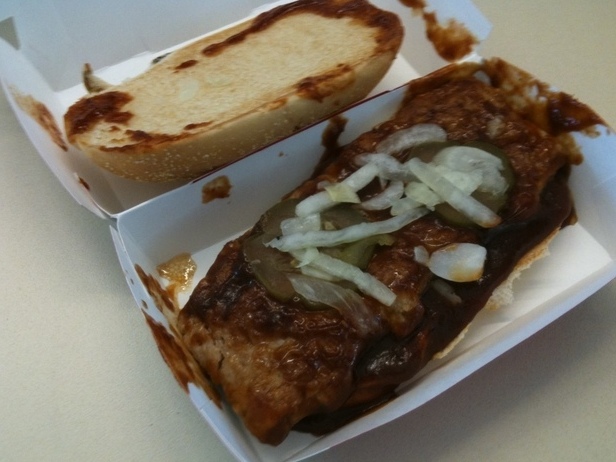
NPR The McRib.

Once again, the signs outside McDonald's say "McRib is Back!" My girlfriend pointed out that it is indeed back. And front, and other parts probably best not to mention.

Eva: This reminds me of particleboard, but with meat.

Ian: It's Particlemeat.

Mike: In the Garden of Eden, God made Eve out of Adam's rib. Then he made Grimace out of a McRib.

Note how the onions and pickles cower together in the center.

NPR Note how the onions and pickles cower together in the center. Note how the onions and pickles cower together in the center.

NPR

You may notice that this year, the McRib has arrived later than usual. Usually, it shows up on menus in October.

Mike: The Shamrock Shake goes with St.Patrick's Day. Why does the McRib come out in October?

Ian: Halloween. It's non-food wearing a food costume.

Eva: Or because it's the living dead.

In this case, "Created Just For You" sounds like a threat.

NPR In this case, "Created Just For You" sounds like a threat. In this case, "Created Just For You" sounds like a threat.

NPR

Peter: I think it only comes out once a year because you need that long to forget it. Like childbirth.

Mike: Or because the gestation period of whatever freakish animal this comes from is 12 months long.

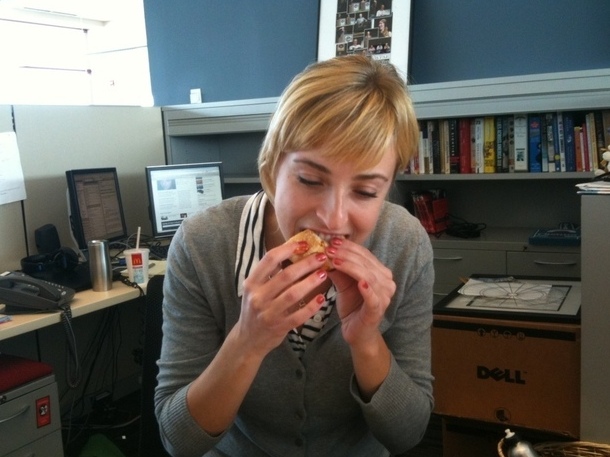
NPR Eva tries it.

Mike: What is this? On the box, it should say "No Animals Were Harmed In The Making of this Sandwich."

Peter: Now that I've had a bite, I'd like to go eat my actual lunch, but I'm afraid to eat.

Ian: Your stomach no longer trusts your hands and mouth.

[The verdict: it doesn't matter. The McRib is just something you have to do. Like puberty. The McRib is like puberty.]

[P.S. Check out this piece about the meat science behind the McRib.]


View the original article here

Sticking With The Sunshine State

On-air challenge: Every answer is a familiar two-word phrase or name in which the first word starts with "F" and the second word starts with "LA."

Last week's challenge: Name a major U.S. city in two words. Take the first letter of the first word and the first two letters of the second word, and they will spell the standard three-letter abbreviation for the state the city is in. What city is it?

Answer: Fort Lauderdale, Fla.

Winner: Mark Sobolik of Newburg, Ore.

Next week's challenge from listener Henri Picciotto of Berkeley, Calif.: Name a two-word geographical location. Remove the first letter. Move one of the other letters to the front of what's left. This will result in a single word that names what you are most likely looking through when you see that geographical location. What is it?

Submit Your Answer

If you know the answer to next week's challenge, submit it here. Listeners who submit correct answers win a chance to play the on-air puzzle. Important: Include a phone number where we can reach you Thursday at 3 p.m. Eastern.


View the original article here

Arab-American Comedienne: No Apology For Jokes

Maysoon Zayid is a Palestinian Muslim with cerebral palsy. She's turned that identity into a tool for laughter, performing stand-up around the world. She says she doesn't apologize to anyone for her very political and personal jokes. Host Michel Martin talks to Zayid about her comedy and a program she runs in the West Bank.

Copyright © 2012 National Public Radio. For personal, noncommercial use only. See Terms of Use. For other uses, prior permission required.

MICHEL MARTIN, HOST:

Switching gears now, the issues of Palestinians, both in the U.S. and abroad, are often in the news, but not, I think it's fair to say, because of the comedy scene, which is where Maysoon Zayid comes in.

MAYSOON ZAYID: I am a Palestinian Muslim virgin with cerebral palsy from New Jersey and, if you don't feel better about yourself, maybe you should. I'm just saying. So I'm a virgin and people are like, really? You're a virgin? And they feel sad for me and I just want you guys to know I'm a virgin by choice and that is my father's choice.

MARTIN: That was Maysoon Zayid on Comedy Central's "The Watch List" in 2008. Her tours have taken her from North America to North Africa to the Middle East and, when she's not entertaining crowds, she's running a nonprofit called Maysoon's Kids. That's a scholarship and wellness program for disabled and refugee children in the West Bank.

We caught up with Maysoon Zayid earlier this year when she was on a break from touring and she's with us now.

Thank you so much for joining us.

ZAYID: Hi. Thank you so much for having me.

MARTIN: So how did you get bitten by the comedy bug? I hear that you actually starting thinking about being an actress.

ZAYID: I actually went to Arizona State University to become a lawyer and was forced to take a fine arts class and I wanted to take the easiest thing they had and my friends told me it was acting because I got to be, like, a tree and an elephant. And, after my first acting class, I switched majors and decided that I was going to become a huge soap star and I was going to be on "General Hospital" and it was going to be amazing.

And I realized very, very quickly that I was never going to be more than an extra because Hollywood didn't really have a place for fluffy, ethnic, disabled people and I wasn't really seeing people that looked like me on television unless they started doing comedy.

So my acting coach at the time, who was a legend, total legend named Tanya Berezin - she suggested to me that I started doing comedy, like Whoopi Goldberg and Rosie O'Donnell and Roseanne Barr and so I went to Caroline's in New York City. I took a comedy class and, by my third, like, open mic, I was professionally doing stand-up comedy.

MARTIN: So you weren't, like, the funny kid in class? You weren't the one that was always getting sent to the principal's office for trying to crack everybody up? That was not you.

ZAYID: I was the girl who did everybody's homework, but I was also, like, student council president and yearbook editor and, like, all-around overachiever, like, I'm disabled, but I can do anything.

MARTIN: Do you mind if I ask? How do your folks feel about this? I mean, you could see where being a super smart kid, head of the class, they might have been thinking dentist, maybe doctor.

ZAYID: No, not really. My parents are very interesting people and I think that they quite enjoy my career. First of all, I love the clip that you played. When I heard it, I was like, oh, my God, this is from such a long time ago because I got married and my father passed away.

MARTIN: Oh, I'm sorry.

ZAYID: God rest his soul. So it's changed a lot, but when I was on stage and my father was alive, he was very proud of what I was doing, because I think my mother and father are both well aware of the fact that I am showing people throughout the world that disability doesn't stop you. And it's not quite as big a deal here in the United States as it is when I perform onstage in Jordan or in Palestine or in Qatar where they're not used to seeing functional disabled people.

MARTIN: Oh, interesting. Yeah.

ZAYID: So I think that, as far as my parents, you know, went, being on Keith Olbermann on a weekly basis wasn't too shabby as compared to, say, being a lawyer or a doctor. And I definitely could have never been a doctor because I have no eye-hand coordination.

MARTIN: OK.

ZAYID: It'd be dangerous. There was, like, five things I could do, one of which was teach, which is what I did until my stand-up comedy took off. I taught seventh and eighth grade reading and English at a Catholic school, like all good Muslim comics do.

MARTIN: Which is scarier, facing a roomful of rowdy comedy patrons or teaching a roomful of seventh and eighth graders?

ZAYID: See, I'm totally fearless. I got my chops in the most, like, dangerous comedy atmosphere. If you can make it in New York, you can really do stand-up anywhere.

MARTIN: I'm Michel Martin. We're speaking with comedienne Maysoon Zayid. Talk a little bit about where we started out. You talked about being born with cerebral palsy. Could you just describe what that is for people who don't know and how it affects you?

ZAYID: It affects my motor skills because the messages from my brain to my body go in all the wrong directions, but they eventually get there, so I shake all the time, kind of like Michael J. Fox meets Tickle Me Elmo with a lot less income.

MARTIN: OK. And you do joke about that or you certainly talk about that.

ZAYID: I do. I talk about that and that was the whole point of the original intro that you played, because what's interesting about me is the fact that people can't tell what's wrong with me and, in a comedy club, it's distracting and it could read as nerves. And if it read as nerves, the audience would be uncomfortable and they wouldn't laugh. So I knew that I needed to get out there something about my disability within the first couple of seconds and that's why I buried it within the intro of, I'm a Palestinian Muslim virgin with cerebral palsy from New Jersey.

Now, the older I got and the more comfortable I got onstage and as a person and as a performer, the more I started doing jokes about the actual disability and how it affects my daily life, but I think one of the reasons people kind of don't know where to place me is because I don't focus on one thing. I don't focus on being a woman and dating, or focus on being married, or focus on being ethnic or being disabled. It's like I am who I am and the comedy I do is very personal, it's very political and I don't apologize to anyone.

MARTIN: Thanks for breaking it down for us in that way. I appreciate it. I did want to ask before we let you go. The organization that you founded, Maysoon's Kids.

ZAYID: Maysoon's Kids.

MARTIN: Want to talk a little bit about it?

ZAYID: Maysoon's Kids is a scholarship and wellness program and what we do is we attempt to raise scholarship money to mainstream physically disabled children into the top schools in the West Bank and we also facilitate adoption for special needs orphans. And we teach moms how to integrate their children into society and we support girls and have a soccer team for at risk girls who we coach through life and coach into college. And we have some kids at Bethlehem University on scholarship. So we're all about educating and empowering, and not just giving people stuff. It's definitely, definitely a teach a kid to have an education program.

MARTIN: How did you come up with the idea for that? Does that come out of your teaching background?

ZAYID: No. Uh uh. And my teaching background was really just like - I qualified to be a sub and someone got pregnant. I got to stay there for a really long time.

MARTIN: That's encouraging.

ZAYID: No. Definitely. No. Maysoon's Kids came from 2002. No. April 2001. I'm sorry. I was watching images on the news of Jenin (unintelligible) being bombed during the Second Intifada by Israel. And I saw this image of a crushed wheelchair and I thought, oh, my God, we're creating an entire new generation of disabled children in Palestine that nobody knows how to deal with. And they need someone who's going to fight for them the way that my father fought for me. Because, like, when I started the school system in New Jersey, they wanted to send me to a school for children with special needs. And the reality is, had I gone to that school, I wouldn't be sitting here talking to you, being a little bit too sarcastic.

MARTIN: Well, thank you for that. I'm happy to listen to you talk about whatever you want to talk about. Before we let you go, I mean, you are - I don't know how you feel about this, being called a role model, but you are a role model for a lot of people in a lot of ways. And I wondered if you had some words of wisdom for someone who might want to follow in your footsteps, who's listening to you and thinking, gee, I think I can do that. I want to do that.

ZAYID: If you're disabled and you're trying to achieve your dreams, accept the fact right now that you have to work 500 times more than the average bear next to you. Stop bucking for sympathy, put on your titanium legs and run.

I think that carries through for all artists - is that, like, if you think that you're so good, go out there and do it and prove it, and work, because nobody's ever going to give you anything. And, if you are handed anything, it's ephemeral and you're going to have to eventually build, anyway. So, like, know that you're worth it and do what you need to do to get there. Don't expect anyone to ever just hand you anything.

MARTIN: Maysoon Zayid is a professional comic. She also runs an education program for disabled and refugee kids in the West Bank. And she was kind enough to join us from New York at the Radio Foundation.

Maysoon Zayid...

ZAYID: And everybody can find me on www.maysoon.com. My name. I bought it.

MARTIN: Maysoon Zayid, thank you for joining us.

ZAYID: Thank you, Michel.

(SOUNDBITE OF MUSIC)

MARTIN: Coming up, R&B singer-songwriter Miguel made a huge splash with his debut album in 2010. Now, he's back with a second album that he hopes will let fans and critics know he's here to stay.

MIGUEL: This album, "Kaleidoscope Dream," is a really great statement for the kind of artist that I hope to become.

MARTIN: A conversation with rising star Miguel and we remember a musical legend, Ravi Shankar. That's all ahead on TELL ME MORE from NPR News. I'm Michel Martin.

(SOUNDBITE OF MUSIC)

Copyright © 2012 National Public Radio. All rights reserved. No quotes from the materials contained herein may be used in any media without attribution to National Public Radio. This transcript is provided for personal, noncommercial use only, pursuant to our Terms of Use. Any other use requires NPR's prior permission. Visit our permissions page for further information.

NPR transcripts are created on a rush deadline by a contractor for NPR, and accuracy and availability may vary. This text may not be in its final form and may be updated or revised in the future. Please be aware that the authoritative record of NPR's programming is the audio.


View the original article here

A Puzzle More Delicious Than A Chard Shard

On-air challenge: Every answer consists of a made-up two-word phrase in which the first word starts with CH, and the second word is pronounced the same as the first except with an SH sound. (The spelling may or may not change.) For example, given the clue "some Central African fish," the answer would be "Chad shad."

Last week's challenge from listener Jim Cohen of Hartsdale, N.Y.: Think of a familiar five-letter word in two syllables. Change the middle letter to the preceding letter of the alphabet, and you'll get a familiar five-letter word in three syllables. What words are these?

Answer: alpha, aloha

Winner: Eric Kaplan of Bogue Chitto, Miss.

Next week's challenge from listener Henry Hook of Brooklyn, N.Y.: In a few weeks something will happen that hasn't happened since 1987. What is it?

Submit Your Answer

If you know the answer to next week's challenge, submit it here. Listeners who submit correct answers win a chance to play the on-air puzzle. Important: Include a phone number where we can reach you Thursday at 3 p.m. Eastern.


View the original article here